
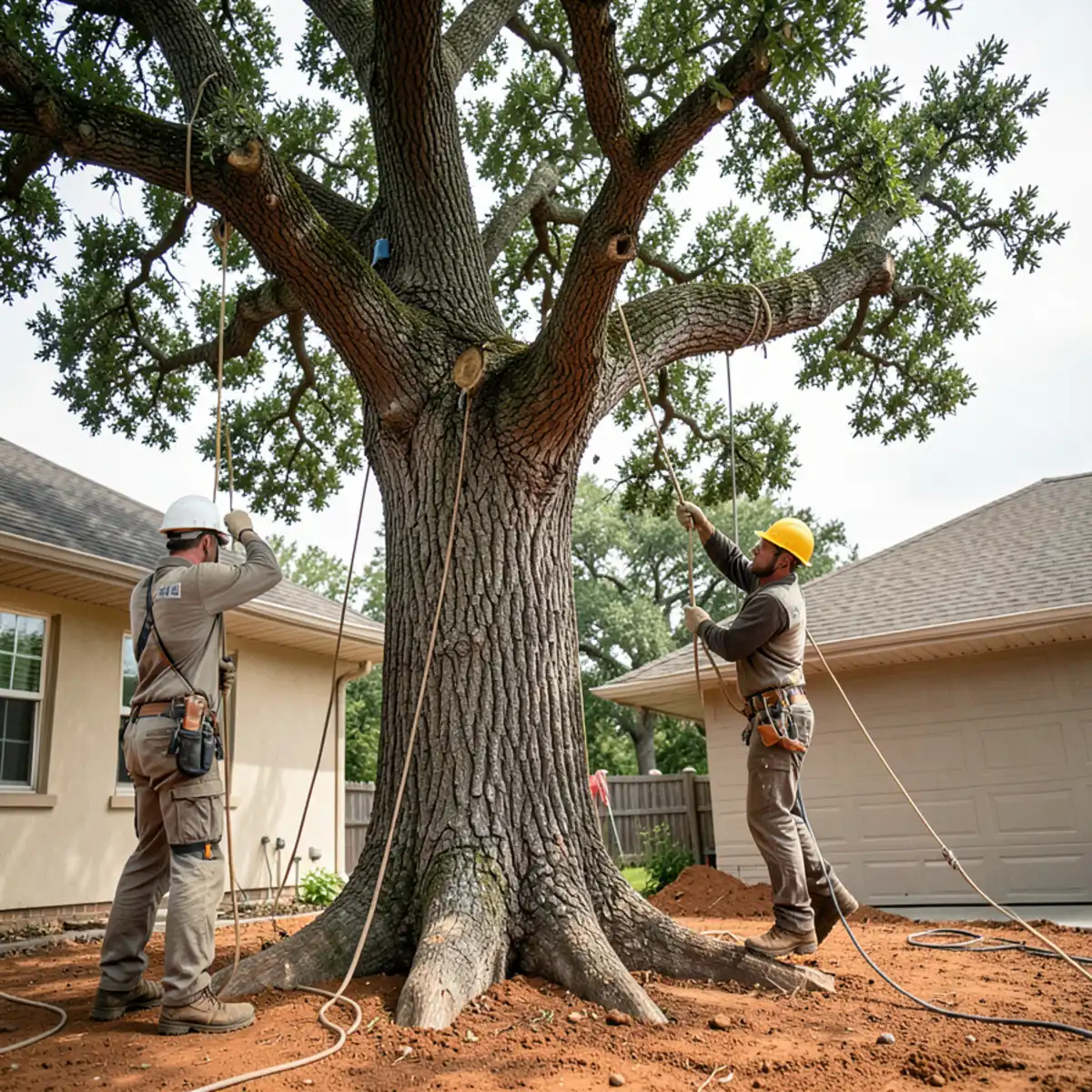
Tree Removal in Fort Worth, TX
Complete, controlled tree removal across Fort Worth and Tarrant County: safe sectional dismantling, crane-assisted rigging over tight structures, and thorough debris haul-away.
Professional Tree Removal Across Fort Worth & Tarrant County
When you need tree removal fort worth tx, connecting with an experienced, well-equipped local tree care specialist ensures the job is done safely and correctly. Whether addressing hazardous limbs overhanging your roof, deadwood from severe summer droughts, or complete sectional dismantling of oversized trees, experienced local tree crews provide controlled operations, transparent pricing, and complete property cleanup.
When property owners require professional tree removal fort worth tx solutions, navigating the unique arboricultural challenges of North Texas requires skilled technical rigging and specialized tree removal equipment. From aging shade trees across the Cultural District and historic West Seventh to expanding acreage properties in Colleyville, finding a dependable tree removal company fort worth property owners can count on is essential for home safety. Whether your property needs residential tree removal services fort worth families rely on for tight fence lines or commercial tree removal services fort worth business campuses schedule for public safety, local independent contractors provide controlled tree removal process methods. Whether searching online for tree removal near me, an emergency tree removal fort worth crew, a trusted arborist fort worth tx consultant, or general tree cutting fort worth yards require, RAM Tree Service is a premier resource for fort worth tree service, connecting homeowners with qualified, independent tree service fort worth texas professionals for safe, hazardous tree removal fort worth properties need. Contractors provide reliable 24/7 emergency service, planned canopy care, urgent emergency tree service, and same day tree service, coordinating residential tree removal fort worth families trust and commercial tree removal fort worth projects with equal precision.
North Texas weather presents acute risks to mature trees, with severe spring supercells, damaging hail, 70 mph straight-line winds, and sudden tornadoes (36 recorded in North/Central Texas in 2025, and 11 through April 2026). In an urgent crisis, emergency tree removal fort worth tx dispatch coordinates rapid assistance for storm damage tree removal, storm damaged tree removal fort worth, and comprehensive tree removal after severe storm fort worth events. When catastrophic weather strikes, tree removal after tornado fort worth emergencies require stabilizing uprooted trunks before clearing structural targets. Technicians address wind damaged tree removal fort worth and perform hazardous dead tree removal fort worth texas properties need after brutal summer droughts. When limbs hang precariously over living areas or secondary utilities, prompt emergency tree removal response time helps mitigate escalating roof punctures and structural collapse, ensuring immediate tree hazard prevention and emergency storm cleanup fort worth residents depend on.
Before deciding to fell a mature tree, property owners benefit from an objective tree risk assessment fort worth tx evaluation or a proactive tree preservation consultation fort worth arborist teams provide. A detailed hazardous tree assessment fort worth tx distinguishes between reversible limb stress and structural failure. When assessing valuable post oaks or live oaks for vascular diseases, following diagnostic guidelines from the Texas A&M Forest Service ensures an accurate oak wilt assessment before initiating any irreversible oak wilt tree removal fort worth or general oak tree removal fort worth tx. When a specimen can be saved, selective crown thinning, arborist steel cabling, and tree trimming fort worth are recommended. However, when root plates heave or fungal conks indicate extensive internal decay, executing a controlled removal under strict tree removal safety standards (ANSI A300 and ANSI Z133) is the only responsible way to protect foundations, fences, and adjacent dwellings, ensuring complete roof and fence protection during limb lowering.
Because the State of Texas does not license tree contractors, property owners searching for a licensed contractor or an insured company must be proactive in their due diligence. Never rely on verbal assurances; always verify current tree removal insurance coverage by requesting a certificate of liability insurance directly from the broker. When evaluating complex jobs—such as crane-assisted large tree removal fort worth tx, precision backyard tree removal fort worth, or delicate tree removal near power lines fort worth—seek a certified arborist tree removal fort worth specialist or an insured tree removal contractor fort worth homeowners can verify to secure verified, insured tree removal fort worth property owners deserve. Always obtain an itemized, written tree removal quote fort worth contractors honor, including a clear free tree removal estimate and free estimate detailing brush chipping, tree debris cleanup, thorough debris removal, and complete tree removal with haul off fort worth alongside tree removal and cleanup fort worth. While some crews discuss tree removal price per diameter inch, overall tree removal cost fort worth averages depend on rigging complexity. Verify whether the scope includes complete tree removal and stump grinding fort worth, combining tree cutting with a stump grinding service, mechanical stump grinding fort worth, and subsurface stump removal fort worth, or whether stump grinding cost fort worth fees are billed separately, and ensure proper fort worth tree removal permit documentation, obtaining a tree removal permit fort worth municipal foresters require, and securing a necessary tree permit is completed before work begins.
First 30 Minutes Storm Emergency Checklist
When severe weather strikes, homeowners often ask: Where should storm damage be documented before cleanup begins? and Is it safe to remove a tree near power lines without utility coordination? Follow this safe sequence before calling a tree crew:
Establish an immediate exclusion zone. Move all family members, pets, and vehicles well beyond the potential fall path of the damaged tree.
Inspect for power line contact. If limbs or trunk touch utility lines, treat the entire tree and ground as energized. Keep back at least 35 feet and call Oncor (1-888-313-4747) or 911 immediately.
Document damage safely. From outside the exclusion zone, take clear photos and videos of the damaged tree, roof impacts, crushed fences, vehicle damage, and foundation lift for your insurance claim.
Call RAM Tree Service at (321) 677-9055 for emergency tree assessment dispatch. Describe whether the trunk is actively shifting, split down the crotch, or resting on a living area.
Coordinate temporary tarping. If tree impact punctures your roof decking, request emergency stabilization and waterproof tarping to stop rainwater intrusion.
Preserve the scene for your adjuster. Avoid disturbing fallen logs or cutting branches until the insurance adjuster and professional tree technicians inspect the damage.
Active Hazard or Split Tree Threatening Your Home?
Stay clear of the fall zone and connect with local emergency tree crews immediately.
Signs Your Tree Requires Immediate Professional Attention
Recognizing structural defects and biological failure early prevents sudden property damage and hazardous limb drops.
Deadwood and Severe Canopy Dieback
Over 50 percent of the upper crown exhibits brittle, leafless limbs, indicating systemic vascular failure, severe drought stress, or root mortality.
Structural Trunk Cracks & Split Crotches
Deep vertical fissures through the heartwood or splitting co-dominant trunks that threaten sudden failure during high-wind events and North Texas supercells.
Basal Cavities, Fungal Conks & Trunk Rot
Bracket fungi or mushroom conks sprouting around the root flare, signaling internal fungal rot, structural hollows, and compromised anchor strength.
Severe Root Plate Heave & Soil Movement
Uprooting root plates lifting driveway pavement, slab foundations, or cracked soil around leaning trunks on expansive Houston Black clay or Eagle Ford shale.
Local Environmental Factors Driving Tree Stress in Fort Worth
- •Prolonged North Texas summer droughts followed by severe spring wind storms and tornadoes (36 recorded in North/Central Texas in 2025, 11 through April 2026).
- •Widespread oak wilt fungus spreading through interconnected root systems in Tarrant County live oaks and red oaks.
- •Shallow limestone rock layers in west Fort Worth and Benbrook restricting root anchoring depth.
- •Biological senescence of 1970s and 1980s builder-planted trees (Arizona ash, silver maple, Bradford pear, hackberry) reaching end-of-life.
- •Expansive blackland clay soils shrinking during drought and swelling in deluges, creating mechanical root shear.
Decision Aid: Causes, Warning Signs & Immediate Action
Homeowners facing sudden tree defects frequently ask: Where can I find emergency tree removal service near Fort Worth? Identify your tree's symptom and take the appropriate safe action before a crew arrives:
| Cause / Hazard | Warning Signs | Immediate Response | Urgency | Who to Call |
|---|---|---|---|---|
| Storm, Hail, High Wind or Tornado Aftermath | Split trunk crotches, heavy hanging limbs (widow-makers), cracked crown, or new severe lean. | Keep people out of the fall zone; photograph from a safe distance; do not climb, pull, or cut. | Immediate assessment when structures, driveways, or public routes are threatened. | 911 or Oncor for live power lines; call (321) 677-9055 for emergency tree removal Fort Worth dispatch. |
| Severe Drought Stress & Root Failure | Lifted soil around root flare, ground fissures, sudden trunk lean, sparse crown, and extensive deadwood. | Vacate the lean zone; avoid parking cars beneath canopy; arrange an on-site structural assessment. | Immediate if soil is actively lifting; prompt if lean is static. | Independent tree contractor or ISA Certified Arborist for a comprehensive tree risk assessment. |
| Oak Wilt Vascular Disease Concern | Rapid leaf bronzing, veinal necrosis, premature leaf drop, and sudden canopy dieback in live or red oaks. | Avoid nonessential oak pruning roughly February 15 to June 15; seal accidental wounds immediately. | Prompt diagnosis; higher seasonal transmission risk during spring months. | ISA Certified Arborist and Texas A&M Forest Service oak wilt specialists for diagnosis. |
| Basal Cavity & Internal Heartwood Decay | Bracket fungi or mushroom conks at the root flare, hollow cavities, carpenter ant activity, decaying wood. | Avoid attaching tow straps, leaning ladders, or attempting backyard felling. | High urgency when the decayed tree stands within striking distance of homes or fences. | Professional tree removal contractor equipped for crane access or sectional rigging. |
| High-Voltage Power Line Conflict | Branches touching primary power lines, arcing sparks, visible smoke, or fallen service drop wires. | Stay away at least 35 feet; keep others away; do not touch vehicles or fences near the tree. | Critical Life-Safety Emergency. | Oncor Electric Delivery (1-888-313-4747) or 911 first; tree service crew only after line is cleared. |
Operational Techniques & Equipment Trade-Offs
Every property in Fort Worth presents unique logistical considerations, from narrow rear alleys in North Richland Hills to wide acreage in Aledo. Independent contractors evaluate which method delivers maximum safety and efficiency:
Sectional Rigging & Lowering (Climbing / Aerial Lift)
Standard method for suburban lots. Tree is dismantled limb by limb using arborist rigging equipment, blocks, and friction brakes. Protects surrounding property but requires intensive labor.
Crane-Assisted Tree Removal
Essential for structurally hollow, decayed, or severely compromised trees that cannot safely support a climber's weight. Hoists massive canopy sections vertically over rooflines with zero ground shock.
Controlled Directional Felling
Trunk is notched and felled in a single controlled direction. Fastest and lowest cost, but strictly limited to large acreage lots with clear, unencumbered drop zones.
What a Contractor Inspects on Site
During your on-site evaluation, the responding tree care specialist conducts a rigorous physical assessment before generating your written quote:
- Trunk Diameter at Breast Height (DBH, measured 4.5 feet above grade) and canopy spread.
- Proximity to structural targets: rooflines, secondary power lines, fences, and swimming pools.
- Underlying soil stability, root flare integrity, and degree of active trunk lean.
- Machinery access clearances through standard residential gates and turf load capacity.
- Need for specialized crane access versus sectional rigging equipment using friction lowering blocks.
Ready for an On-Site Tree Evaluation?
Free to call with zero obligation. Connected directly with a local tree pro.
Call (321) 677-9055Tree Removal Versus Pruning, Cabling & Preservation
A common dilemma is: When does a tree need removal instead of pruning or treatment? and When is oak tree pruning or removal safest in North Texas? Consider whether structural preservation is viable:
Single Broken Scaffold Branch or Localized Storm Damage
Target Pruning & Deadwood RemovalWhen the primary trunk, root flare, and over 60 percent of the canopy remain healthy, precision crown thinning and deadwood removal restore balance without removing the entire tree.
Co-Dominant Stems with Tight V-Shaped Crotch (No Active Split)
Arborist Cabling & Bracing SystemInstalling flexible high-strength arborist steel cabling across upper limb unions reduces wind oscillation and prevents storm splits, extending the safe life of mature shade trees.
Root Plate Heave, Split Trunk Heartwood, or Severe Oak Wilt
Controlled Sectional Tree RemovalWhen anchor roots shear or vascular decay exceeds structural thresholds, the tree becomes an unpredictable hazard. Removal is the only responsible way to protect life and property.
To protect Tarrant County oaks against fungal spread by nitidulid sap beetles, avoid all non-essential pruning or cutting of live oaks and red oaks roughly between February 15 and June 15. For storm-damaged or emergency limb removals during this period, paint fresh cuts immediately with commercial wound sealant.
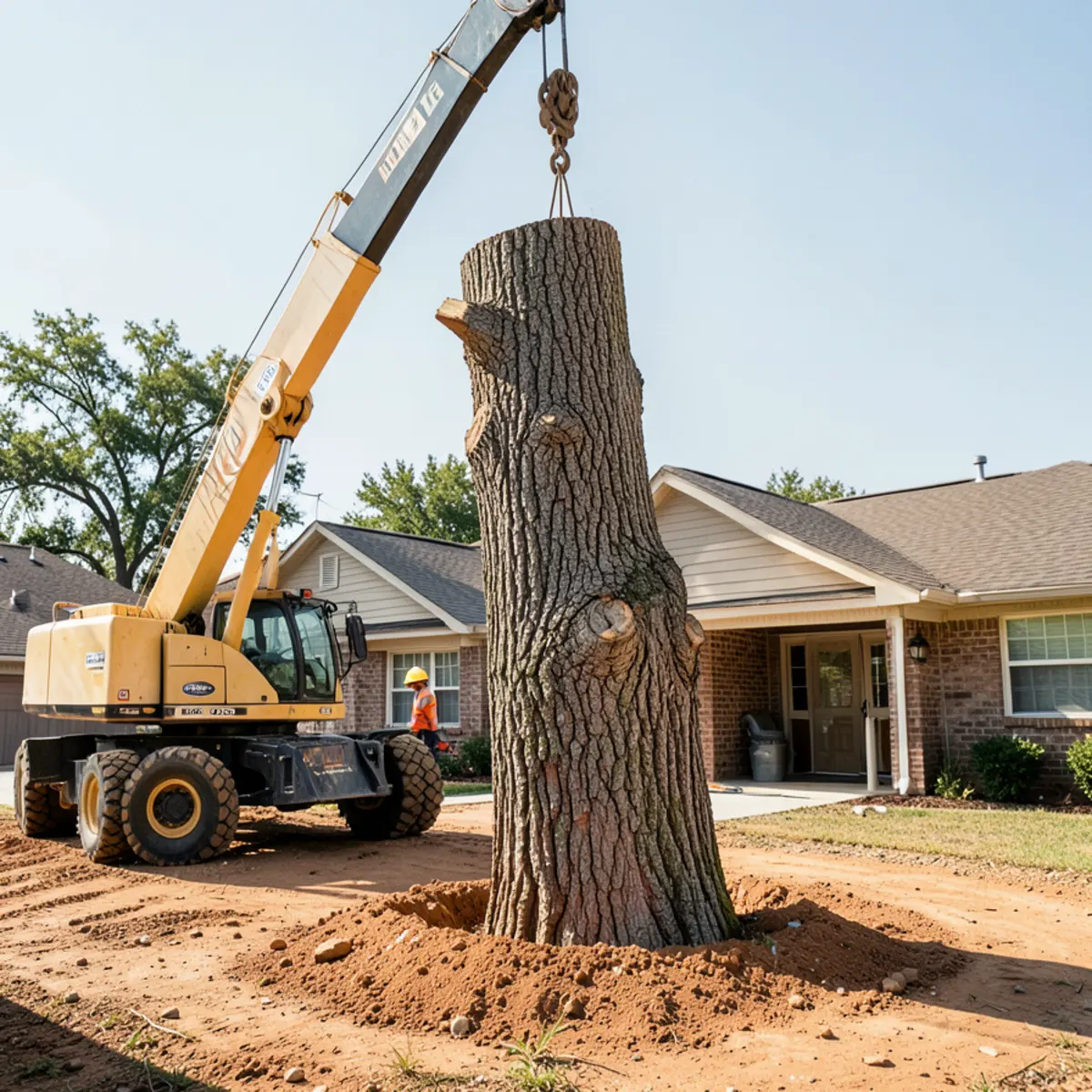
Crane-assisted vertical rigging over structures prevents secondary roof impact when trees cannot support a climber.
The Tree Removal Process: What to Expect
A transparent, step-by-step workflow from your initial telephone call to final yard raking.
Step 1: On-Site Hazard & Access Inspection
A local contractor evaluates tree health, structural lean, proximity to your home, and gate access. You receive an itemized, written tree removal quote detailing the scope.
Step 2: Drop Zone Preparation & Rigging Setup
Ground crew secures an exclusion zone, lays heavy composite ground-protection mats over turf, and installs rigging lines and lowering blocks in stable anchor unions.
Step 3: Sectional Canopy & Trunk Dismantling
Climbers or bucket truck operators methodically cut and lower outer branches, scaffold limbs, and trunk logs in controlled sections, guiding each piece safely to the drop zone.
Step 4: Wood Chipping, Haul-Off & Lawn Raking
Brush and limbs are processed through industrial wood chippers. Heavy logs are loaded for transport, and work areas are raked and blown clear of wood shavings.
What Drives Tree Removal Costs in Fort Worth?
Tree service pricing is never one-size-fits-all. Published local market averages provide helpful guidance, but final costs require a physical on-site assessment.
Key Pricing Drivers
Typical Regional Price Benchmarks
Published typical local ranges for the Fort Worth / Tarrant County market. Final price determined after on-site evaluation:
Includes crepe myrtles, young elms, and ornamental pears with clear drop zones. Attributed local market range.
Includes mature Arizona ash, hackberries, and mid-sized post oaks near property boundaries.
Includes multi-trunk pecans, towering live oaks over houses, and storm-split trees requiring crane extraction.
Line-Item Written Quote Comparison Checklist
Before signing a contract, property owners ask: Which questions should I ask before hiring a tree removal company? and Is stump grinding included in standard tree removal service? Protect your property by comparing bids line by line. Never accept a single unexplained lump-sum total:
| Scope Item | What an Honest Quote Includes | Warning Sign / Red Flag |
|---|---|---|
| Tree Dismantling & Rigging Method | Specifies controlled sectional rigging, lowering blocks, bucket truck, or crane access. Details the drop zone and exclusion zone. | Vague estimate stating only 'cut down tree' with no description of lowering methods or property protection. |
| Stump Grinding Depth & Chip Handling | Defines grinding depth (typically 6–10 inches below grade), surface root chasing, and whether wood shavings are raked level or hauled away. | Contractor assumes 'tree removal' means leaving a high stump unless you pay an unexpected add-on fee. |
| Brush Chipping & Heavy Timber Haul-Off | Includes complete wood chipping, heavy trunk log loading, rake-out of wood shavings, and sweeping driveways clear. | Leaving massive trunk logs stacked on your curb or charging unquoted landfill disposal fees. |
| Ground & Lawn Protection Measures | Explicit commitment to lay composite ground-protection mats over soft lawns and shield sprinkler heads, siding, and landscape beds. | Driving heavy skid steers or trucks directly across saturated blackland clay lawns without turf protection boards. |
| Fort Worth Urban Forestry Permit Compliance | Identifies whether 24"+ DBH native trees or 18"+ post oaks require city permits, and confirms City Forester coordination for parkway trees. | Contractor advises removing protected heritage trees without verifying municipal permit requirements. |
| Proof of General Liability Insurance | Provides an active certificate of insurance issued directly by the carrier, verifying adequate property damage coverage. | Verbal statement of 'we are fully insured' without a written certificate showing active policy dates. |
| Payment Milestones & Written Change Orders | Clearly states deposit terms, milestone payments, and requires written approval before unpriced crane time or additional haul-off begins. | Demanding 100 percent upfront payment in cash or presenting surprise price hikes after cutting is halfway done. |
Where We Dispatch Tree Removal Crews
Connecting property owners across our ~35-minute service radius from west Fort Worth:
Tree Removal in North Richland Hills
50-year-old trees overhanging 1970s ranch roofs
Fort Worth Neighborhood Terrain & Access Considerations
Every district in Fort Worth presents distinct arboricultural and logistical realities:
West Seventh & Near Southside
Access: Narrow residential lot widths, zero-lot lines, and side fence gates under 36 inches require specialized compact log carriers or crane picks hoisted over rooflines.
Clearfork & Trinity River Corridor
Access: Alluvial river soils and high water tables require heavy ground protection mats to support equipment without creating deep turf ruts.
Fort Worth Stockyards & Northside
Access: Historic commercial buildings, alleyway overhead wires, and tight rear easements demanding precision sectional rigging through arborist lowering blocks.
Camp Bowie District & Ridglea
Access: Sprawling 1930s–1950s ranch homes with long lateral oak limbs overhanging composite roofs, requiring bucket trucks and precision clearance cuts.
Riverside & River East
Access: Steeply sloping terrain and drainage ravines requiring heavy winch lines, taglines, and controlled lowering down grades.
Consumer Protection: Verifying Tree Contractors in Fort Worth
Protect your home, family, and finances by following these essential verification steps before signing:
The Texas Licensing Reality
The State of Texas does not issue a general tree removal contractor license. Anyone with a chainsaw and a truck can legally offer tree cutting. Because there is no state licensing board overseeing tree removal, property owners must be diligent in verifying contractor qualifications, business references, and insurance certificates directly.
Verifying ISA Certified Arborist Credentials
When assessing mature shade trees, oak wilt symptoms, or structural stability, seek a professional holding an International Society of Arboriculture (ISA) credential. You can verify an arborist's current certification status online at treesaregood.org using their certification number or full name.
Texas Department of Agriculture (TDA) Licensing
If your tree care proposal includes chemical treatments—such as systemic micro-injections for oak wilt suppression or pest control—the applicator must hold an active commercial pesticide applicator license issued by the Texas Department of Agriculture. Request their TDA license number before authorizing chemical treatments.
Certificate of General Liability Insurance (COI)
Always ask for a Certificate of Insurance issued directly from the contractor's insurance broker, naming you as certificate holder. Ensure the policy covers tree felling, rigging operations, and structural property damage with minimum limits of $1,000,000.
Adherence to ANSI A300 & ANSI Z133 Standards
Reputable tree care professionals operate strictly under ANSI A300 industry standards for tree pruning and care, and ANSI Z133 arboricultural safety standards. These standards govern proper rigging, personal protective equipment (PPE), chainsaw handling, and exclusion zone safety.
Related Tree Care Services
Related Local Research Guides
Tree Removal Frequently Asked Questions
Straightforward answers regarding tree removal processes, city regulations, and estimates in Fort Worth.
What does tree removal cost in Fort Worth, TX?
What is included in a Fort Worth tree removal quote?
What are the signs that a tree is hazardous?
How quickly can an emergency tree removal crew respond after a storm?
How does the tree removal process protect roofs, fences, lawns, and nearby structures?
How can I compare tree removal quotes in Fort Worth?
Why do drought, high winds, and root failure make trees dangerous in Fort Worth?
Why should I hire an insured tree removal contractor or ISA Certified Arborist?
Can homeowners insurance pay for storm-damaged tree removal?
Does Fort Worth require a permit to remove a hazardous or dying tree?
Request Your Free On-Site Tree Removal Estimate
Call (321) 677-9055 today. Connect with an independent local tree contractor serving your specific Fort Worth or Tarrant County neighborhood.