
Direct Answer & Local Summary
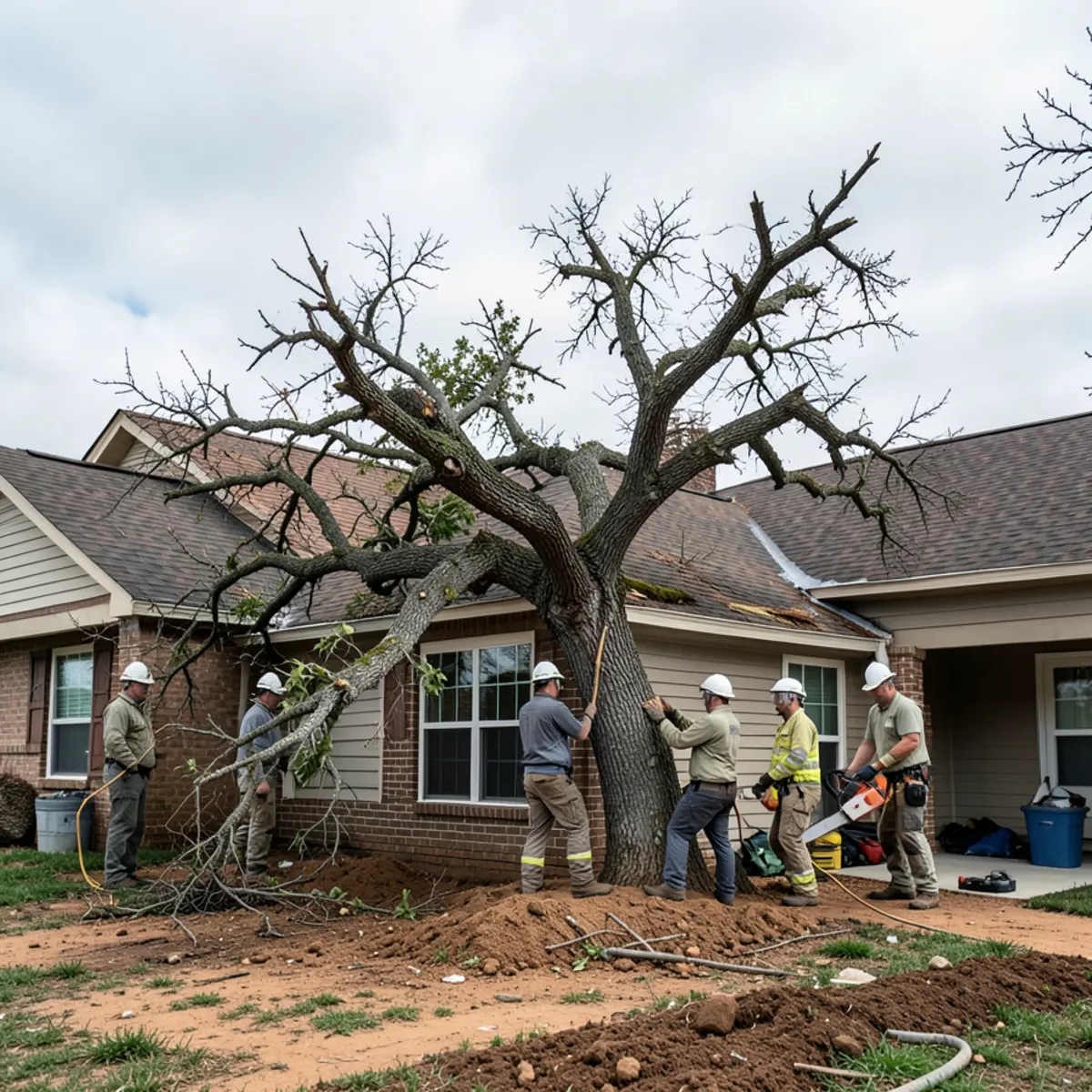
If a tree has fallen on your house in Fort Worth, evacuate the affected rooms immediately and ensure all family members and pets are in a secure area. If the tree contacted any utility wires, assume they are energized, stay clear, and call Oncor at 888-313-4747 or dial 911 immediately. From a safe distance, take clear photographs and videos of the damage for your insurance claim, then call our emergency dispatch line at (321) 677-9055 to get a licensed local emergency tree crew en route for stabilization, crane extraction, and emergency roof tarping.
Key Takeaways for Property Owners
- •Never enter a room where a fallen tree or limb has punctured or cracked the ceiling.
- •Always treat power lines tangled with tree limbs as fully energized until cleared by Oncor.
- •Photograph all angles of the tree, structure impact, and interior damage before any debris is moved.
- •Most Texas homeowners policies cover tree removal from a structure and temporary emergency tarping.
Step 1: Life-Safety & Immediate Evacuation
The moment a tree impacts your home, your primary concern is personal safety. Heavy tree trunks exert immense downward structural load that can cause delayed framing collapse, cracked rafters, or shattered window glass hours after the initial strike.
Evacuate everyone away from the impact zone to the opposite side of the home or outside to a safe structure. If you smell natural gas or hear hissing, turn off your main gas shutoff valve if accessible and evacuate the property immediately.
Need Tree Assistance in Fort Worth?
Free telephone connection with independent local tree service pros.
Step 2: Electrical Hazard Assessment & Oncor Coordination
North Texas thunderstorms regularly tear down overhead electrical service drops connecting alley poles to residential weatherheads. If tree branches touch or pull down any wire, do not touch the tree, gutters, or metal fencing.
Call Oncor Electric Delivery directly at 888-313-4747 or dial 911. Tree contractors cannot legally or safely cut limbs touching energized high-voltage lines until Oncor technicians isolate the power circuit.
Step 3: Comprehensive Damage Documentation for Insurance Adjusters
Before any chainsaw cuts are made, thoroughly document the scene. Take high-resolution photos and video clips showing the entire fallen tree, where it landed on your roof, punctured decking, broken windows, and damaged gutters.
Also photograph interior ceiling cracks, sagging drywall, or water leaks. Keep all documentation organized for your insurance adjuster. Most Texas homeowners policies cover the reasonable cost of tree extraction from a covered structure and emergency tarping under the 'reasonable repairs' clause.
Step 4: Professional Emergency Extraction & Crane Rigging
Never attempt to cut a tree off your roof with a personal chainsaw. Fallen trees are under intense compression and tension forces; cutting the wrong limb can cause the heavy trunk to roll or crash deeper into your living room.
Professional emergency tree crews utilize 40-to-60 ton mobile cranes or heavy winch rigging to lift the trunk vertically off your roof decking before sectional cutting begins, completely eliminating secondary structural damage.
Step 5: Emergency Weatherproofing & Roof Tarping
Once the heavy wood is hoisted clear, responding crews secure heavy-duty, waterproof polyethylene tarps over exposed roof punctures and damaged decking.
Securing tarps with wooden 2x4 battens stops rainwater penetration into your attic insulation and ceilings while you coordinate with roofing contractors and insurance adjusters.
Expert Rigging Insights: How Crews Extract Heavy Trees Without Extra Roof Damage
Lifting thousands of pounds of hardwood timber resting on a structural roof requires acute mechanical calculation. Inexperienced attempts to cut logs while they bear weight on rafters cause secondary buckling, shifting loads that puncture through ceilings below.
Professional emergency operators employ dynamic rigging: tree trunks are chocked and secured with arborist winches or suspended from a mobile hydraulic crane. By establishing an upward tension pull equal to the log weight before severing branches, technicians perform zero-impact extraction where pieces are hoisted skyward without grinding against asphalt shingles or sheathing.
Frequently Asked Questions: Tree Fell on Your House in Fort Worth? What to Do First
Straightforward answers grounded in Texas municipal codes, insurance standards, and regional forestry guidelines.
Will homeowners insurance cover tree removal if the tree fell on my driveway instead of my roof?
What should I do if a tree falls on my power line during a Fort Worth storm?
How quickly does emergency tarping need to be installed after a tree is removed from my roof?
RAM Tree Service Editorial Desk · Fort Worth, TX
Researched from municipal forestry ordinances, Texas A&M Forest Service data, and ISA arboricultural standards. For on-site estimates, call our dispatch line at (321) 677-9055.
Official References & Forestry Authorities Cited
Our editorial team consults municipal codes, state forestry extensions, and industry standards to ensure guidance reflects current North Texas conditions:
- •Texas Department of Insurance (TDI): Consumer Guide to Property Insurance and Storm DamageOfficial Texas guidelines on storm damage claims and emergency mitigation requirements.
- •Oncor Electric Delivery: Downed Power Line and Tree Safety ProtocolGuidance on utility line safety during storm-related tree emergencies.
- •City of Fort Worth Office of Emergency Management: Emergency Management & Storm PreparednessMunicipal resources and post-storm recovery procedures across Tarrant County.