
Direct Answer & Local Summary
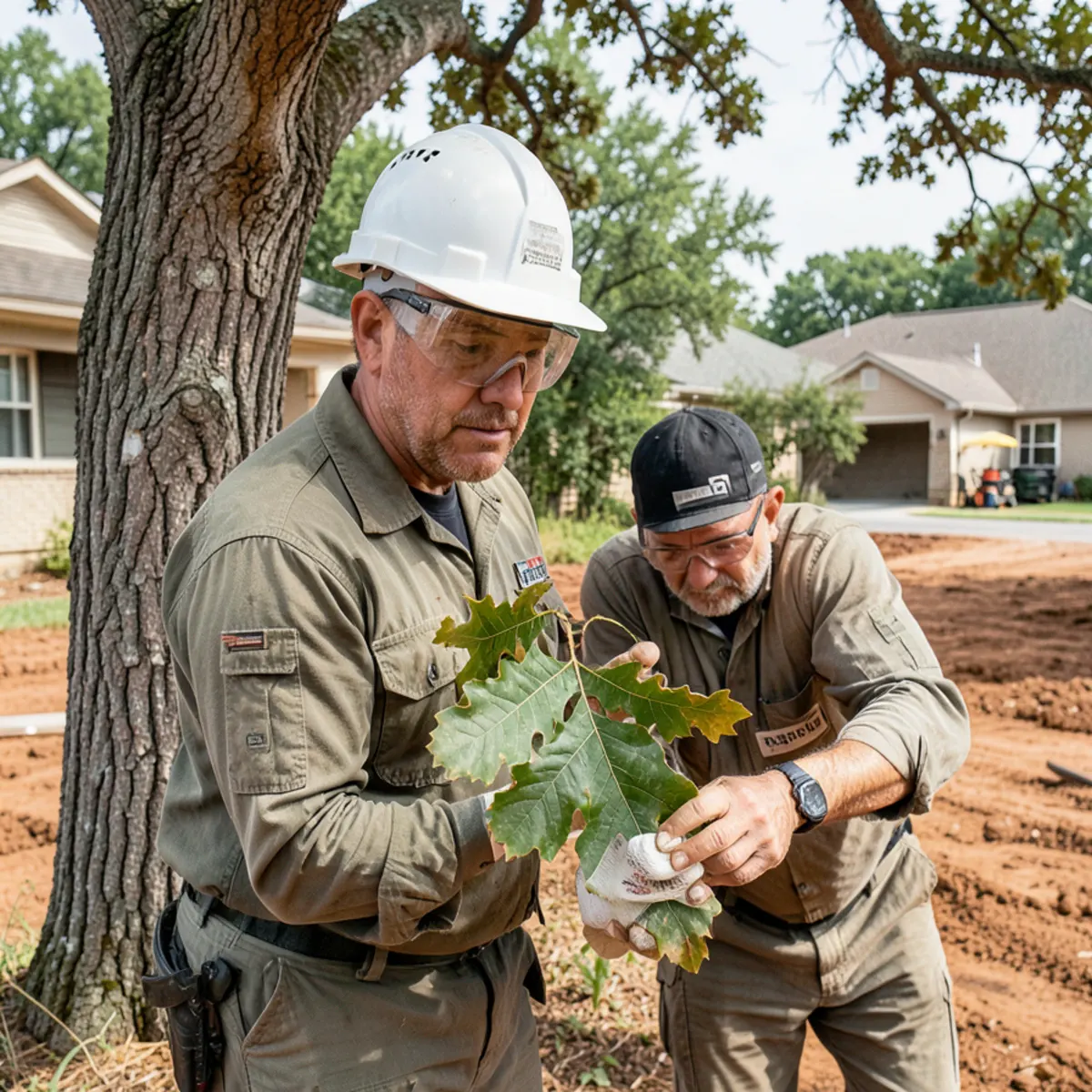
In Tarrant County, oak wilt (caused by the fungal pathogen Bretziella fagacearum) kills both live oaks and red oaks by clogging their water-conducting vascular systems. In live oaks, the diagnostic symptom is veinal chlorosis, where leaf veins turn bright yellow or brown while the remaining leaf blade stays green, followed by rapid leaf drop. In red oaks (including Spanish oak and Shumard red oak), entire canopies turn reddish-brown within two to four weeks. While systemic fungicide injections (propiconazole) can protect healthy oaks within a disease center, once a tree exhibits advanced canopy collapse, it cannot be cured. Infected red oaks must be removed promptly and their wood properly disposed of to prevent the formation of spore mats that infect new trees.
Key Takeaways for Property Owners
- •Veinal chlorosis (yellow/brown leaf veins with green blades) is the hallmark symptom in live oaks.
- •Red oaks die rapidly within weeks and form fungal spore mats that spread the disease via sap beetles.
- •Oak wilt spreads underground through interconnected root grafts at rates of 50 to 100 feet per year.
- •Infected red oak firewood should never be transported or stored near healthy oaks.
What Causes Oak Wilt and How Does It Spread?
Oak wilt is caused by the vascular fungus Bretziella fagacearum. The disease attacks the tree's xylem vessels, prompting the tree to produce tyloses (balloon-like cell blockages) in a desperate attempt to seal off the infection, which ultimately strangles its own water transport.
The disease spreads through two primary vectors in North Texas:
1. Underground Root Grafts: Live oaks naturally form interconnected root networks with neighboring live oaks. The fungus travels directly through these grafted root systems, expanding outward in expanding disease centers.
2. Insect Vectors (Nitidulid Sap Beetles): In spring, fungal mats develop beneath the bark of infected red oaks. Tiny sap-feeding beetles visit these sweet-smelling mats, become covered in fungal spores, and fly to fresh pruning wounds on healthy oaks.
Need Tree Assistance in Fort Worth?
Free telephone connection with independent local tree service pros.
Live Oaks vs. Red Oaks: How Symptoms Differ
Live Oak Symptoms: Live oaks show chronic progressive decline. The defining sign is veinal chlorosis—the veins of the leaf turn bright yellow or bronze while the margins remain green. Trees typically drop massive amounts of green and bronze leaves in mid-summer, with 80 to 85 percent of infected live oaks dying over 1 to 2 years.
Red Oak Symptoms: Red oaks (Shumard oak, Texas red oak) are exceptionally vulnerable. Once infected, leaves wilt, turn dull bronze or oily green, and remain clinging to branches. Total crown death typically occurs within 3 to 6 weeks.
When Does an Infected Oak Need to Come Down?
For infected red oaks, immediate removal is critical. Dead and dying red oaks produce fungal spore mats during the subsequent spring, acting as reservoirs that spread the disease to nearby neighborhoods in Keller, Southlake, and Fort Worth.
For live oaks, trees with over 50 percent canopy collapse that fail to respond to therapeutic fungicide injections should be removed to eliminate falling limb hazards over roofs and patios.
Safe Wood Disposal & Sanitation Practices
Infected red oak wood must never be kept as firewood or chipped into uncomposted mulch in areas with healthy oaks. Responding tree contractors haul infected red oak logs to designated deep-burial or commercial composting facilities.
Infected live oak wood does not produce spore mats and can be safely chipped or used for firewood on-site once thoroughly dried.
Expert Disease Management: Trenching and Root Flare Injection Trade-Offs
Managing oak wilt across residential neighborhoods in Keller, Southlake, and Fort Worth requires understanding the limitations of chemical treatments. Therapeutic micro-injections of Alamo (propiconazole) fungicide into root flares can suppress symptoms in asymptomatic live oaks, but it does not cure the tree or kill the fungus in connected roots.
To stop expanding disease centers, forestry specialists utilize mechanical vibratory plows or rock trenchers to cut root connections at a depth of 4 to 5 feet, at least 100 feet ahead of visible symptoms. While trenching is invasive and disrupts turf, it remains the only proven method to halt subterranean fungus transmission.
Frequently Asked Questions: Oak Wilt in Tarrant County: When an Oak Must Come Down
Straightforward answers grounded in Texas municipal codes, insurance standards, and regional forestry guidelines.
Can an oak tree survive if it gets oak wilt in North Texas?
How far away from an infected oak tree can the disease spread underground?
Is it safe to use red oak wood for firewood if the tree died of oak wilt?
RAM Tree Service Editorial Desk · Fort Worth, TX
Researched from municipal forestry ordinances, Texas A&M Forest Service data, and ISA arboricultural standards. For on-site estimates, call our dispatch line at (321) 677-9055.
Official References & Forestry Authorities Cited
Our editorial team consults municipal codes, state forestry extensions, and industry standards to ensure guidance reflects current North Texas conditions:
- •Texas A&M Forest Service & ISA Texas: Texas Oak Wilt Information PartnershipComprehensive scientific database on oak wilt identification, biology, and prevention in Texas.
- •Texas A&M AgriLife Extension Service: Oak Wilt Identification and Management in North TexasDiagnostic criteria and chemical injection protocols for Texas property owners.
- •Texas A&M Forest Service Urban Forestry: Tarrant County Oak Wilt Spread MappingGeographic distribution of active oak wilt disease centers across North Texas.